July 2026 Market Commentary
Market Update and Economic Developments
- The U.S. economy continued to demonstrate resilience in July. Employment conditions remained healthy, consumer spending stayed positive, and corporate earnings generally exceeded expectations. Growth has moderated from the exceptionally strong pace seen earlier in the recovery, but activity remains consistent with an expansionary environment.
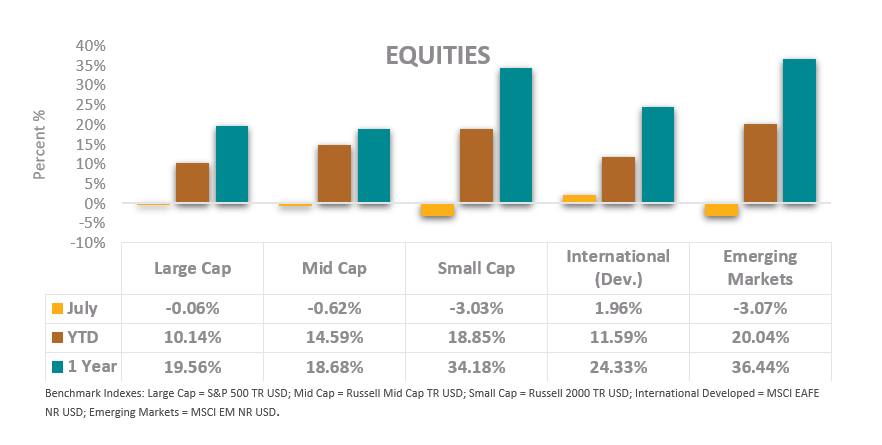
- For the month of July, the S&P 500 was essentially flat and the Russell 2000 posted only a modest decline, reflecting a market pause after a strong second-quarter rebound rather than the sharper risk-off environment of 1996.
- International markets were comparatively resilient. Developed international equities, as measured by the MSCI EAFE Index, posted a modest gain, while emerging markets were more mixed following a very strong first half. This continued a broader shift that began in 2025, when international equities meaningfully outpaced U.S. stocks after an extended period of U.S. market leadership — a rotation supported by more attractive starting valuations, a weaker U.S. dollar, and broader participation beyond U.S. mega-cap growth names.
- Artificial intelligence remained one of the market’s most influential themes during July. While broader equity markets were relatively subdued, global semiconductor and memory-chip stocks experienced significant volatility as investors evaluated the sustainability of AI-related spending. Companies such as SK Hynix, Samsung Electronics, and Micron Technology continued to benefit from extraordinary demand for High Bandwidth Memory (HBM), a critical component in AI servers and advanced computing systems. After experiencing a mid-month pullback driven largely by valuation concerns, many AI infrastructure and memory-chip companies rebounded sharply late in the month as strong cloud-computing results reinforced expectations for continued investment in AI infrastructure. The month’s trading activity underscored a growing recognition that beneficiaries of the AI revolution extend well beyond large technology platforms and increasingly include the global semiconductor supply chain supporting this technological transformation.
Fixed Income Market Update
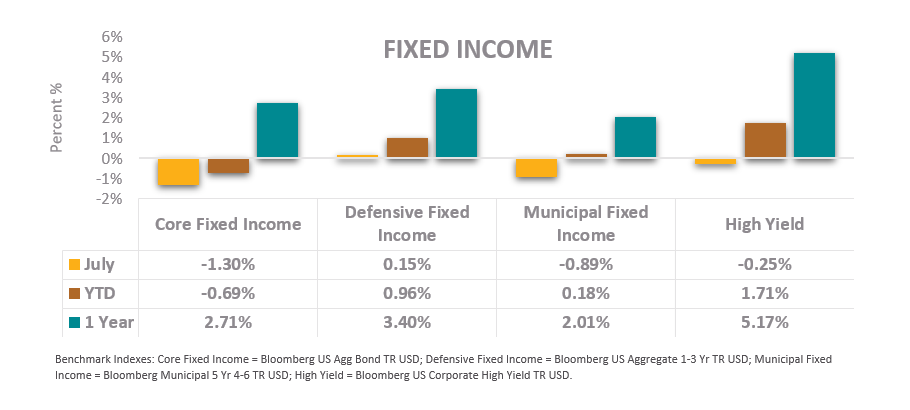
- This July, core bonds came under pressure as longer-term Treasury yields rose, causing the Bloomberg U.S. Aggregate Bond Index to fall 1.3% and turn negative for the year. Importantly, the weakness was driven primarily by duration risk and a steeper yield curve, not by deteriorating corporate credit conditions.
- Inflation continued to trend lower toward the Federal Reserve’s 2% target. Despite the downward move, the Fed left rates unchanged at 3.50–3.75% at its late-July meeting, with a 9–3 vote that included three dissents favoring a hike. New Chairman Kevin Warsh struck a hawkish tone in his press conference, reiterating the need for lower inflation without committing to a specific policy path — a stance that contributed to a back-up in longer-term Treasury yields into month-end which remained positively sloped, with longer-maturity yields modestly above short-term rates — a notable change from the deeply inverted curve that characterized much of 2023 through early 2025, and a shift generally viewed as a healthier signal for economic growth and bank lending activity.
- While market leadership has broadened beyond the Magnificent Seven compared with prior years, fundamentals remain generally supportive of both equities and fixed income. Volatility is likely to persist as markets calibrate expectations for monetary policy, but the backdrop of moderating inflation, positive economic growth, and improving market breadth remains constructive for long-term investors.
Mission’s market and investment commentaries reflect the analysis, interpretation, and economic views and opinions of our investment team. They are not intended to provide investment advice for any individual situation. Please contact us if we can provide insight and advice for your specific needs.
