
September 2026 Market Commentary

Equities
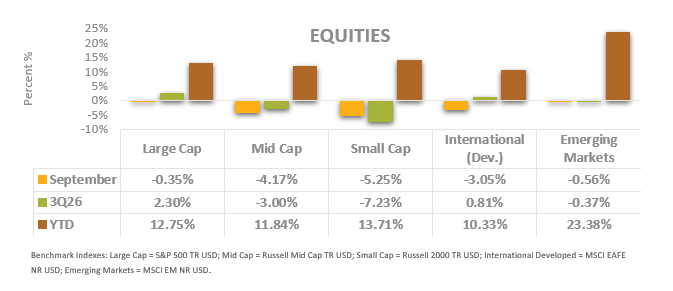
U.S. equities were down in September, a seasonally weak month for the S&P 500, as higher interest rates weighed on investor sentiment. As a result of strong earnings growth, S&P 500 valuation forward multiples have compressed during 2026. The index entered the year trading around 22 times forward earnings but finished the third quarter at roughly 19 times, leaving valuations meaningfully less stretched and closer to longer term averages. Earnings growth in AI related industries has powered the US market return in 2026 as companies must invest in this technology to maintain their competitive advantage. The market’s return this year has been driven by impressive earnings growth however the rate of those earnings growth is expected to slow into 2027. There is no denying the AI revolution is here to stay.
The S&P 500 saw a small decline of -0.35% in September, with large-cap stocks proving relatively resilient relative to other equity markets around the globe. Smaller companies experienced greater pressure from tighter financial conditions, with the Russell 2000 declining more than 5% during the month. The equal weight S&P 500 began to lag the broader S&P 500 in September as the largest names in the index returned to their dominance in pushing markets to near all-time highs.
International markets also weakened. The MSCI EAFE Index declined approximately 3% in September, although developed international equities remained strong performers for the year. Emerging markets faced similar crosscurrents, as continued global economic growth provided support while rising interest rates and elevated energy prices presented headwinds.
The Fed Changes the Conversation
Entering the final quarter of the year, a different reality has set in for investors. To begin 2026, the Federal Reserve was expected to continue lowering the federal funds rate by as many as 3 times. Instead, after one increase to the policy rate in September the Fed is expected to continue a path of more restrictive interest rate policy to end the year. Expectations for lower interest rates have given way to renewed concerns about persistent inflation, resilient economic growth and restrictive monetary policy. September reinforced that shift as the Federal Reserve raised rates by 0.25%, to 3.75%-4.00% while longer-term Treasury yields moved sharply higher.
The significance of September’s Federal Reserve meeting extended beyond the quarter-point increase. For much of the past several years, investors have focused on when monetary policy would become less restrictive. September brought the possibility of higher-for-longer interest rates back to the forefront.
That shift was particularly evident in the Treasury market. The 10-year Treasury yield ended in September at around 5.3%, while the 30-year yield climbed above 5.6%, reaching levels not seen in more than two decades. The rise reflected more than expectations for Fed policy. Persistent inflation, higher energy prices, large federal deficits and the growing amount of Treasury debt that markets must absorb also contributed to upward pressure on yields.
Fixed Income
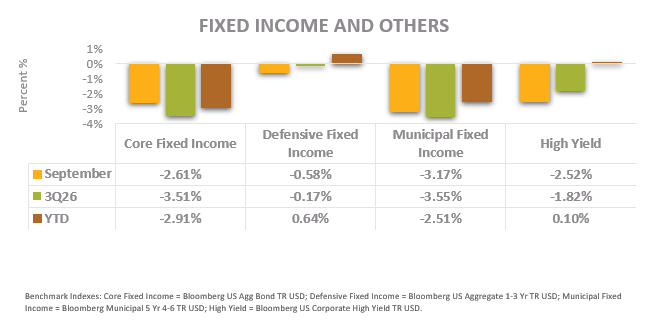
The sharp increase in rates weighed on fixed-income returns. The Bloomberg U.S. Aggregate Bond Index declined more than 2% in September, while investment-grade and high-yield credit spreads widened. Despite near-term losses, higher starting yields improve the forward-looking return potential for bond investors, providing greater income and a larger cushion against future volatility. Bonds are also becoming a more compelling alternative to equities after years when exceptionally low yields encouraged investors to move further out on the risk spectrum.
Looking Ahead to the Fourth Quarter
As we enter the final three months of 2026, inflation and long-term interest rates will likely remain at the center of the market outlook. The Fed’s September projections showed a median year-end federal funds rate of 4.1%, indicating that policymakers expect rates to remain elevated as they work to bring inflation back toward the 2% target.
The direction of longer-term Treasury yields may be equally important. A sustained 10-year yield of around or above 5% would keep financial conditions tight, affecting mortgage rates, corporate borrowing costs and financial-asset valuations. Fiscal deficits, Treasury issuance, energy prices and geopolitical developments could add further pressure.
Corporate earnings will also become increasingly important. With high-quality bonds offering more attractive yields, companies must produce earnings growth sufficient to justify equity valuations. At the same time, continued economic resilience provides a constructive foundation if inflation can begin to moderate.
The central question heading into year-end is whether economic growth can remain healthy while inflation moves lower. If it can, the Fed may eventually have greater flexibility to step back from further tightening. If inflation remains stubborn, investors may need to adjust to an environment in which interest rates remain elevated longer than previously anticipated. Either outcome is likely to create both challenges and opportunities for diversified investors.
Expectations for lower interest rates have shifted toward higher-for-longer, but changing markets also create new opportunities. Higher bond yields and greater dispersion across asset classes reinforce the value of a diversified, long-term approach.
Disclaimer
Past performance is not indicative of future results. Indices are unmanaged, cannot be invested in directly, and returns do not reflect fees, expenses, or transaction costs.
Sources used in preparing this commentary include the Federal Reserve Bank of St. Louis (FRED), J.P. Morgan Asset Management, Yahoo Finance, Investing.com, FedSmith, Income Research + Management, Annaly Capital Management, Safe Rate, S&P Global Market Intelligence, and U.S. Bank Economic Research Group. These sources were referenced for Federal Reserve policy and economic projections, equity and fixed income market performance, Treasury yields, inflation, and U.S. and global economic conditions.Fixed income commentary references a decline of approximately 2.6% in the Bloomberg U.S. Aggregate Bond Index based on the reported -2.59% return of the TSP F Fund, which tracks the index.
Chart Source: Morningstar Direct. Large Cap = S&P 500 TR USD; Mid Cap = Russell Mid Cap TR USD; Small Cap = Russell 2000 TR USD; International Developed = MSCI EAFE NR USD; Emerging Markets = MSCI EM NR USD; Core Fixed Income = Bloomberg US Agg Bond TR USD; Defensive Fixed Income = Bloomberg US Aggregate 1-3 Yr TR USD; Municipal Fixed Income = Bloomberg Municipal 5 Yr 4-6 TR USD; High Yield = Bloomberg US Corporate High Yield TR USD. If applicable, the statistical analysis contained herein was prepared by Innovest Portfolio Solutions LLC and may contain data provided by Investment Metrics, LLC, Thomson Reuters Lipper, Morningstar, Inc., and other sources. These materials may also include information, returns, and valuations that were compiled, computed, or created by Standard & Poor’s Financial Services LLC, MSCI Inc., and other sources. These materials and the information that they contain are intended solely for the use of the intended recipient(s). They may not be reproduced or distributed without written consent.
Mission’s market and investment commentaries reflect the analysis, interpretation, and economic views and opinions of our investment team. They are not intended to provide investment advice for any individual situation. Please contact us if we can provide insight and advice for your specific needs.
